
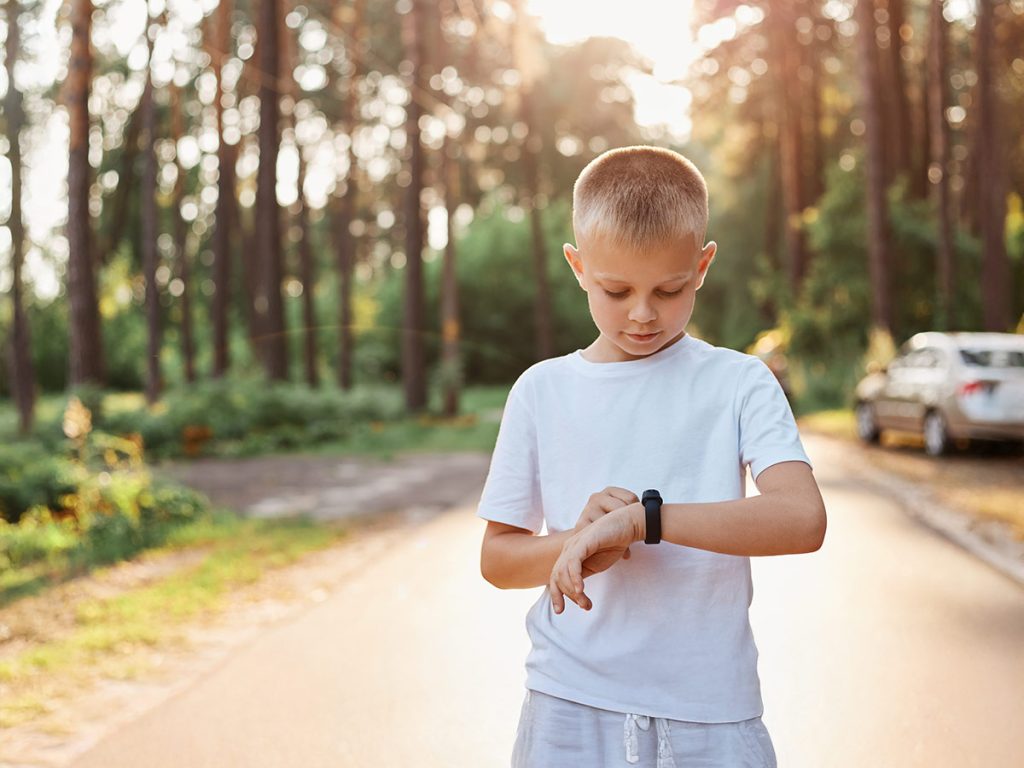
GPS trackers for kids are growing in popularity because they help parents track their kids’ whereabouts and increase their safety. But how do GPS trackers for kids work, what types are there, and what should parents look out for when buying one? Read on to learn all you need to know about GPS trackers for kids. Also discover how Avira Free Security, Avira Antivirus Security for Android, and Avira Free Mobile Security for iOS can help improve your security and privacy when using a GPS tracker.
What is a GPS tracker and how does one work?
A GPS tracker is a device used to determine the location of a person or object. To do this, it uses GPS (the Global Positioning System) — a worldwide satellite network that sends signals to the tracker. The GPS tracker then uses these signals to calculate its exact position. Following that, it uses a mobile network or Wi-Fi to transmit its location data to a child-tracking app on the parents’ smartphone.
Some GPS trackers can have additional features, such as an SOS emergency button, a call function, or geofencing capabilities. With this geofencing feature, parents can set a safe zone for their child — if their kid leaves it, parents receive a push notification. Data is transmitted in real time, so parents can access their child’s location at any time via an app on their smartphone.
Types of GPS trackers for kids
GPS trackers for kids differ in how they work, how comfortable they are to wear, and how they can be used. Each variant has pros and cons that parents should weigh up prior to getting one.
GPS watches for children
GPS watches are a popular option because they can be worn comfortably on the wrist. They usually have an integrated GPS module, a cellular module to transmit their location, a telephone function, and an SOS button.
- Pros: Many GPS watches have a call function, an emergency button, and a school mode that restricts non-essential features to minimize distractions. And perhaps most importantly, they aren’t easy to lose.
- Cons: Due to the limited battery life, these smartwatches need to be charged regularly. Additionally, larger models can be uncomfortable for small children. Compared to other GPS trackers, GPS watches are often more expensive.
GPS tags or tracking transmitters for kids
These compact trackers can be attached to a backpack, clothing, or a keychain. They’re less conspicuous than GPS watches and offer similar features.
- Advantages: GPS tags or tracking transmitters are compact, lightweight, easy to attach, and unobtrusive. Compared to GPS watches, they’re often a more cost-effective option.
- Cons: The devices can get lost easily or removed without being noticed — and they don’t have a direct-call feature.
Smartphones with GPS tracking apps
Instead of a special GPS tracker, you can also use a smartphone with a tracking app for kids. These apps allow parents to determine their child’s location via GPS.
- Advantages: If your child already has a smartphone, you don’t need an additional device. Smartphones with GPS tracking apps offer a variety of features such as calling, messaging, internet access, and the ability to install parental-control apps.
- Disadvantages: A smartphone cannot be located if the battery is flat or the GPS is turned off.
SIM-free GPS trackers for kids
Some models use Bluetooth or Wi-Fi instead of a cellular network, making them perfect for use in indoor environments or situations when kids remain close to their parents.
- Pros: There are no monthly costs for mobile phone contracts. This variant consumes less power, giving it a longer battery life.
- Cons: Since the device only works via Wi-Fi or Bluetooth, the tracker’s range is limited and you won’t be able to track your kid in real time outside the home.
Age-appropriate selection of GPS trackers
Choosing the right GPS tracker depends largely on the child’s age and individual needs. Younger children often benefit from simpler devices with fewer features, while older children can benefit from more advanced features such as calling or text messaging.
- Children aged 3 to 6 years: Go for an easy-to-use GPS tracker with robust housing. A GPS tag or GPS watch with an SOS button is ideal for them as younger children are often not yet able to operate complex devices. The device should also be waterproof in case it comes into contact with water while playing.
- Children between 7 and 12 years: A GPS watch with advanced features is a good choice. This age group often already travels to school or with friends independently, so features like a call function or geofencing are helpful. Some GPS watches can send voice or text messages, allowing parents to keep in touch with their kids.
- 12 years and over: Many children of this age already have a smartphone, so a good alternative to a GPS tracker could be a GPS tracking app on the child’s smartphone. This can be combined with a parental-control app to both manage mobile phone usage and securely retrieve location data. Parents should still consider carefully whether a tracking app is sufficient or whether a dedicated GPS tracker is the better solution.
What should parents look for when buying a GPS tracker?
When purchasing a GPS tracker for kids, parents should pay particular attention to data protection, security, network coverage, and ease of use.
- Privacy and security: The provider should be GDPR compliant and securely encrypt the location data (AES-256 or end-to-end encryption). EU servers offer better protection against data misuse.
- SIM card and network coverage: Many trackers require a nano or micro SIM card with a mobile data plan. Good network coverage is crucial, as is the choice between a prepaid card and a contract, which often offers a more stable connection.
- Location accuracy and battery: Good trackers use GPS, Wi-Fi, and a mobile network for more precise tracking. With live tracking, parents can track their child’s location in real time. The battery life should be at least 1 to 7 days, and the device should ideally have a power-saving mode.
- Features and operation: Intuitive app control, geofencing (virtual security zones), and an emergency call button all enhance user-friendliness. Voice and text messages are additional features to consider.
- Robustness and comfort: Trackers should be waterproof, shockproof, and comfortable to wear — like a watch or tag.
- Cost and subscriptions: In addition to the purchase price of €50 to €200 (approx. $60 to $230), monthly fees or SIM card costs may apply. Some trackers come bundled with plans.
Are GPS trackers for kids safe and privacy-friendly?
GPS trackers for kids help parents monitor their child’s location. However, these devices raise important concerns about data protection and data security. To ensure their kids are fully protected, parents should therefore think about combining GPS tracking with secure browser settings and a parental-control app.
- Trusted vendors: A reputable provider will store location data on EU servers and comply with the requirements of the General Data Protection Regulation (GDPR). The privacy policy should be transparent regarding which data is collected, stored, and shared. Providers that anonymize location data offer better privacy protection.
- Secure Data encryption: To ensure location data is protected and to prevent misuse, GPS trackers should only use secure encryption methods such as AES-256 encryption, which is also used in the banking sector. End-to-end encryption (E2EE) guarantees that data is protected throughout its entire transmission. SSL/TLS encryption protects the connection between the tracker and the app from eavesdropping.
- Protection from cybergrooming and stalkerware: Parents should check the GPS tracker settings regularly and see which apps have access to the location. High battery consumption, unexplained data usage, or background location queries can be signs of unauthorized access. For security reasons, only use trustworthy apps, restrict permissions, and use security software. Remove suspicious apps immediately.
- iPhone parental controls: A useful addition to location monitoring is to use Apple parental-control tools.
Pros and cons of GPS trackers for kids
GPS trackers offer parents greater security because they can track their child’s location in real time, allowing them to respond quickly in case of danger. Features such as geofencing (virtual security zones) or emergency buttons provide additional protection mechanisms. A tracker can be particularly reassuring for parents when they have small children or are in unfamiliar surroundings.
However, there are also disadvantages. Constant tracking can undermine trust between parents and children and foster a sense of excessive control. There is also a risk of data misuse if the provider is lax about data protection. Technical limitations such as limited battery life, poor network coverage, or lack of precision can also reduce the tracker’s reliability. So, before using a GPS tracker, take time to reflect and have an open chat with your child.
Avira Free Security for GPS tracker users
The safety of GPS trackers for kids depends not only on the quality of the hardware but also on the protection of the connected smartphone or tablet. Avira Free Security provides comprehensive protection for PCs, Macs, and mobile devices, ensuring that private data, including location information, doesn’t fall into the wrong hands. The apps Avira Antivirus Security for Android and Avira Mobile Security for iOS are specially developed for mobile devices and protect against stalkerware, malware, and unauthorized access. They detect and remove apps that secretly collect location data or which might compromise the security of the devices, playing a critical role to keep your kids safe online.
Avira also offers a secure VPN connection that encrypts communication between the GPS tracker and the app, preventing location data from being intercepted or misused. With features like anti-theft protection and device tracking, parents can ensure their child’s smartphone is always protected and can be found quickly even if it goes missing. By combining a GPS tracker with Avira’s proven security software, the child’s location remains protected and parents can enjoy maximum control and security.